Last Updated: April 2026 | 11 min read
Only 18% of US healthcare organizations report confidence in their understanding of ICD-11, according to AHIMA. Meanwhile, WHO’s February 16, 2026 release introduced DORIS 1.2 and a new validation framework called CoDEdiT, signaling that global ICD-11 infrastructure is maturing faster than US adoption planning. That’s not a comfortable gap to be sitting in.
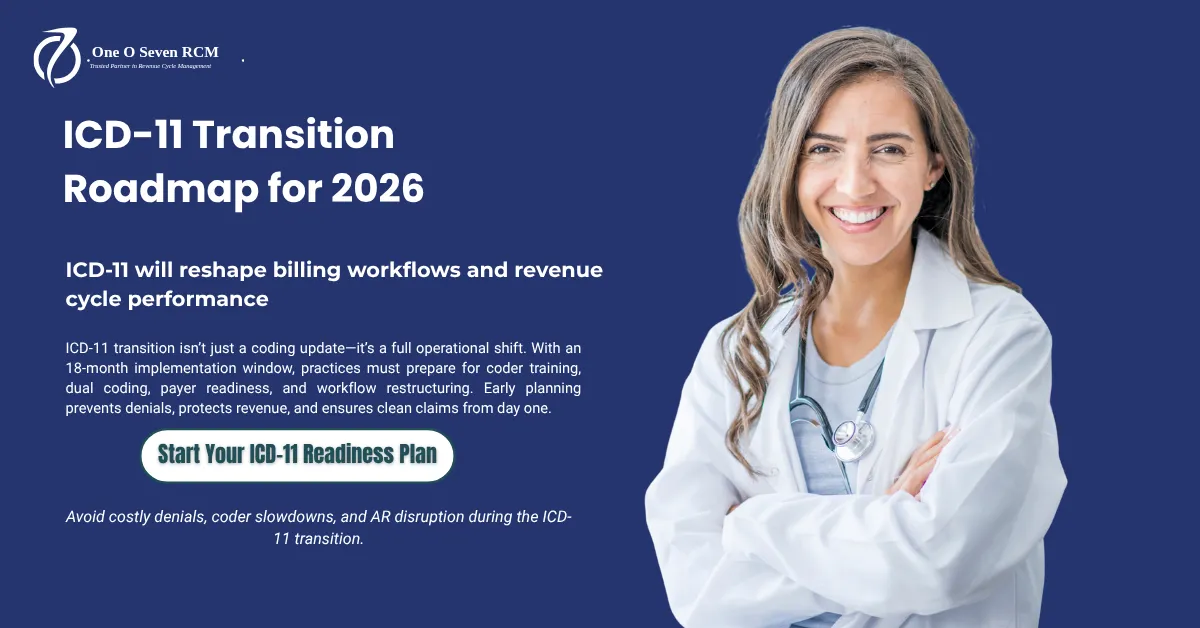
The ICD-11 transition is not a coding upgrade. It is an operational restructuring of the entire revenue cycle that requires 18 months of phased preparation across coder certification, EHR vendor coordination, payer readiness validation, and dual coding pilots. Practices that begin in 2026 will be the practices that bill cleanly when the mandate arrives.
The NCVHS ICD-11 Workgroup is targeting 2027 to 2029 for US billing implementation. That sounds distant. It isn’t. WHO’s own implementation guidance estimates four to five years for full transition in mature healthcare systems. That math places the preparation window squarely in 2026, not 2027.
This is not an introduction to ICD-11. It’s the operational roadmap that a practice administrator, RCM director, or hospital revenue officer can hand to their team and execute. One O Seven RCM has guided 240+ multi-provider practice transitions across coding system changes and ICD-11 implementation programs. Our 47-Point ICD-11 Readiness Audit is the methodology behind this roadmap.
By the end of this guide, you’ll know exactly what to do in months one through six, months seven through 12, and months 13 through 18. That’s the commitment.
What’s Inside This Guide
Here’s what we’ll cover, in the order your implementation team needs it.
- Why the ICD-11 Transition Is a 2026 Decision, Not a 2027 Problem
- The 18-Month ICD-11 Transition Roadmap: Phase by Phase
- Inside ICD-11 Code Architecture: Stem Codes, Extension Codes, and Post-Coordination
- Reengineering Your Claim Submission Workflow for ICD-11
- The Payer and Clearinghouse Readiness Crisis Most Practices Are Ignoring
- The Dual Coding Pilot: How to Run ICD-10 and ICD-11 in Parallel
- ICD-11 Coder Certification Pathways: AHIMA, AAPC, and the WHO Benchmark
- Specialty-Specific ICD-11 Considerations
- Inside the 47-Point ICD-11 Readiness Audit
- What an Unprepared ICD-11 Transition Will Cost Your Practice
- How One O Seven RCM Operationalizes Your ICD-11 Transition
- Frequently Asked Questions About the ICD-11 Transition
- The 18-Month Window Is Open Now
Why the ICD-11 Transition Is a 2026 Decision, Not a 2027 Problem
Healthcare practices should begin ICD-11 transition planning no later than Q1 2026. The NCVHS targets 2027 to 2029 for US billing implementation. That’s a 12 to 36 month preparation window, which is the minimum time required for coder training, EHR vendor coordination, payer readiness validation, and a meaningful dual coding pilot. Beginning ICD-11 implementation later compresses every phase dangerously.
The ICD-11 transition has already started globally. What hasn’t started yet is the US billing mandate. Those are two different clocks, and most practices are only watching one of them.
WHO ICD-11 Infrastructure Is Already Operational
WHO’s February 2026 release built on the 2024 and 2025 updates. DORIS 1.2 is live. The CoDEdiT validation framework is active. The ICD-11 API supports real-time code validation across 21 languages. Over 6.3 million searchable code combinations are now available at icd.who.int. None of this is theoretical or forthcoming. It’s in production today.
US Payer and Clearinghouse Testing Is Underway
CMS continues mandating ICD-10-CM and ICD-10-PCS for all HIPAA-covered transactions as of 2026. But the NCVHS ICD-11 Workgroup Phase II evaluation is in progress. Major clearinghouses are running internal ICD-11 testing environments. Most practices don’t see this work because it happens at the payer-clearinghouse layer, not the provider layer. That invisibility is the risk.
The Post-Coordination Learning Curve Sets the Real Timeline
AHIMA estimates 60 to 100 hours of post-coordination training per coder, meaning a six-coder practice faces 360 to 600 hours of total training time before a dual coding pilot can begin. That’s a scheduling reality that places the preparation window firmly in 2026, not 2027. You can’t compress this. You can only plan for it.
The question isn’t whether to begin ICD-11 preparation. It’s which 18-month window your practice chooses to begin it in. Practices that start in Q1 2026 will be production-ready by Q3 2027. Practices that start in Q3 2027 will be unprepared at any conceivable mandate date. Start your readiness assessment with One O Seven RCM before your window closes.
The 18-Month ICD-11 Transition Roadmap: Phase by Phase
A successful ICD-11 transition follows a three-phase, 18-month sequence: months one through six build foundation through governance and audit, months seven through 12 build capability through certification and pilot, and months 13 through 18 build production readiness through expanded dual coding and payer validation. That structure aligns directly with WHO’s published four to five year implementation envelope at the practice level. ICD-11 implementation planning that skips any phase arrives at cutover with gaps that are expensive to close under live billing pressure.
This roadmap is derived from three sources: WHO implementation guidance, AHIMA training hour estimates, and the average payer testing window from prior US coding system transitions.
Phase 1: Foundation (Months 1 Through 6)
In months one through six, your practice establishes the implementation governance structure, completes the 47-Point ICD-11 Readiness Audit, identifies the high-volume code categories requiring the most retraining, and begins coder training enrollment.
Phase 1 deliverables:
- An appointed ICD-11 Transition Lead with documented accountability and a reporting cadence
- A completed readiness audit with a prioritized gap remediation list
- A top-50 ICD-10 code utilization analysis cross-referenced against ICD-11 stem codes
- A written commitment from your EHR vendor on their ICD-11 timeline
- At least 50% of coding staff enrolled in AHIMA or AAPC ICD-11 certification programs
Phase 1 success criteria: By Month 6, your practice has full visibility into every infrastructure decision required for the transition. No surprises remain.
The 47-Point ICD-11 Readiness Audit is the Phase 1 entry point. It produces the gap remediation list that all subsequent phases operationalize against. Request One O Seven RCM’s 47-Point ICD-11 Readiness Audit to begin Phase 1 with a documented starting position.
Phase 2: Capability Building (Months 7 Through 12)
In months seven through 12, your practice builds the operational capabilities the transition demands. Coders complete certification. EHR vendors release ICD-11 testing environments. The first dual coding pilot begins on a calibration set of 100 to 500 cases.
Phase 2 deliverables:
- 100% of billing-relevant coders certified or in active certification programs
- EHR test environment configured for dual ICD-10 and ICD-11 code entry
- Dual coding pilot completed on 100 to 500 cases with full discrepancy analysis
- Payer-specific testing pathways identified and documented in a transition matrix
- Clearinghouse readiness confirmed in writing with a specific ICD-11 go-live date
Phase 2 success criteria: By Month 12, your practice can produce both ICD-10 and ICD-11 codes for any case type, with documented accuracy benchmarks against the WHO field study reference of 71.9% diagnostic accuracy.
Phase 3: Production Readiness (Months 13 Through 18)
In months 13 through 18, your practice expands the dual coding pilot to your full case mix, validates payer adjudication of ICD-11 claims in test environments, finalizes the cutover playbook, and establishes the post-cutover monitoring cadence.
Phase 3 deliverables:
- Dual coding expanded to 100% of new claims with shadow ICD-11 coding running in parallel
- Payer test claim acceptance rate above 95% across your top five payers
- Denial pattern analysis from test claims completed with a remediation plan
- A cutover playbook documenting every system, workflow, and reporting change
- A Day-1 to Day-90 monitoring schedule with daily denial rate reporting
Phase 3 success criteria: By Month 18, your practice can execute an ICD-11 cutover within 30 days of any CMS announcement without operational disruption.
The roadmap looks demanding because the transition is demanding. Practices that compress this 18-month plan into nine months won’t arrive ready. They’ll arrive partially prepared, which during a billing transition is functionally indistinguishable from unprepared. Practices that prefer to delegate implementation can engage One O Seven’s outsourced medical billing services for end-to-end transition execution.
Inside ICD-11 Code Architecture: Stem Codes, Extension Codes, and the Post-Coordination Logic Your Coders Must Master
Post-coordination is the ICD-11 mechanism that allows coders to combine a stem code with one or more extension codes to fully describe a clinical encounter. Unlike ICD-10’s single-code approach, post-coordination treats a diagnosis as a cluster of related codes. The cluster must follow ICD-11 syntax rules to be valid for billing. Mastering that syntax is the skill that separates ICD-11-ready coders from ICD-10-trained coders applying old logic to new codes.
In ICD-11, a billing-grade diagnosis is no longer a single code but a syntactically valid cluster of one stem code and zero or more extension codes. The difference between a clean claim and a denied claim now lives in cluster construction. That’s a learned skill, not a lookup.
Example 1: Type 2 Diabetes with Foot Ulcer
ICD-10 approach: E11.621 (one code handles everything)
ICD-11 approach: The coder selects the stem code for Type 2 diabetes mellitus (5A11), then adds extension codes for the complication type (foot ulcer), the anatomical location (specific foot region), and the severity of the ulcer. Each extension code must be a syntactically valid addition to the cluster. An invalid extension code combination fails at the clearinghouse layer before it ever reaches the payer.
The clinical picture is the same. The code construction is fundamentally different.
Example 2: Myocardial Infarction with Anatomical Specification
ICD-10 approach: A single code from the I21 category captures the MI with some anatomical detail.
ICD-11 approach: The coder builds a cluster around the MI stem code, adding extension codes for the specific coronary artery involved, the anatomical territory affected, and whether the event is initial or subsequent. Hospital coding teams working at high volumes face this cluster construction on every cardiac case. Inpatient coding under ICD-11 adds complexity that DRG assignment models are still being recalibrated to handle.
Example 3: Major Depressive Disorder with Episode Specification
ICD-10 approach: Codes from the F32 or F33 range capture the episode type with some severity.
ICD-11 approach: The coder selects the mood disorders stem code and adds extension codes specifying the episode type, severity, presence of psychotic features, and course specifier. ICD-11’s mental and behavioral disorders chapter has been substantially restructured. Behavioral health practices can’t rely on their ICD-10 pattern recognition here. The chapter logic changed, not just the code numbers.
Why Post-Coordination Is the Skill That Separates ICD-11-Ready Coders
Post-coordination logic is the single skill that distinguishes ICD-11-ready coders from ICD-10-trained coders. AHIMA and AAPC certification programs both emphasize this skill above all others because it can’t be improvised. Invalid cluster construction is the primary source of ICD-11 claim failures at the clearinghouse layer.
Connect with One O Seven RCM’s ICD-11 training team to evaluate your coders’ post-coordination readiness before Phase 2 begins. See the WHO ICD-11 Browser and the WHO ICD-11 post-coordination guidance for the syntax reference standards your coders need to learn.
Reengineering Your Claim Submission Workflow for ICD-11
ICD-11 changes six discrete steps of the billing workflow: documentation capture, code selection, cluster validation, crosswalk mapping, denial triage, and reporting. A successful transition requires that all six be reengineered, documented, and trained before the first ICD-11 claim is submitted, not during it.
ICD-11 doesn’t change what the billing department does. It changes how every step of the workflow gets performed. That distinction matters for ICD-11 medical billing teams because it means every workflow step must be reengineered, documented, and trained. You can’t apply ICD-10 process logic to ICD-11 workflows and expect clean claims.
Step 1: Documentation Capture
Clinical documentation must support extension code selection. Vague documentation that worked under ICD-10 fails under ICD-11. EHR templates must prompt providers for severity, laterality, anatomical location, and underlying cause when relevant to the encounter. This is a provider-facing workflow change, not just a coder-facing one.
Step 2: Code Selection
Coders no longer search for one code. They construct a cluster. EHR coding tools must support cluster construction with validation against WHO ICD-11 syntax rules. The WHO ICD-11 Coding Tool is the reference standard for cluster validation during training and during the dual coding pilot.
Step 3: Cluster Validation
Before claim submission, every code cluster must be validated for syntactic correctness. Invalid clusters generate clearinghouse rejections that appear as new failure types in 837 transaction error logs. Your billing team must learn to read these new error patterns. They don’t look like ICD-10 rejections, and treating them the same way wastes time.
Step 4: Crosswalk Mapping
Until payer systems fully adopt ICD-11, claims may need bidirectional mapping between ICD-11 and ICD-10 for certain payers. Crosswalk logic must be configured at the practice management or clearinghouse layer before any live ICD-11 claims are submitted. Don’t discover the mapping gap at the submission layer.
Step 5: Denial Triage
ICD-11-related denials cluster differently than ICD-10 denials. Your denial management workflows must include ICD-11-specific categorization and appeal templates. One O Seven RCM’s 47-Point ICD-11 Readiness Audit produces a denial taxonomy specifically for transition-period denials, so your team knows what to look for before the first denial arrives.
Step 6: Reporting and Analytics
Existing denial dashboards, AR aging reports, and clean claim rate metrics must be updated to handle new denial patterns and the dual coding period. Reporting that aggregates ICD-10 and ICD-11 claims without distinction will mask transition-specific issues. You can’t fix what you can’t see in the data.
Each of these six changes is manageable in isolation. The cumulative effect is a substantially different billing workflow. Practices that document the new workflow before the transition will train their teams once. Practices that don’t will train them three or four times during the transition, with revenue cycle disruption between each iteration. Our outsourced medical billing services include all six workflow reengineering steps as part of our ICD-11 transition program.
The Payer and Clearinghouse Readiness Crisis Most Practices Are Ignoring
The binding constraint on ICD-11 implementation is not provider readiness. It’s the readiness of the EHR vendor, the clearinghouse, and the payers. A practice that prepares its team without auditing these three external infrastructure layers will discover at cutover that it can’t transmit a single ICD-11 claim.
Provider readiness is necessary but not sufficient. A practice can be perfectly trained, perfectly documented, and perfectly tooled, and still fail to bill in ICD-11 if its clearinghouse isn’t ready or its largest payers aren’t accepting ICD-11 claims. Most practices don’t audit this layer. That’s the crisis.
EHR Vendor Readiness: The Five Questions Every Practice Must Ask
Most major EHR platforms have public roadmaps targeting ICD-11 capability between 2026 and 2028. General roadmaps aren’t enough. ICD-11 EHR readiness means your specific vendor has committed in writing to a specific date with specific capabilities confirmed. Ask these five questions:
- Does your system support multi-part ICD-11 code cluster storage?
- What is your ICD-11 API integration timeline with the WHO ICD-API?
- Will your system support dual ICD-10 and ICD-11 entry during the transition period?
- How will your coding tool handle post-coordination extension code selection and syntax validation?
- What ICD-11 training resources are you providing with the update?
A vendor who can’t answer these questions clearly doesn’t have an ICD-11 readiness plan. HIMSS analytics on EHR vendor readiness and HL7 FHIR ICD-11 terminology binding documentation are the reference frameworks for evaluating vendor responses. Our 47-Point ICD-11 Readiness Audit includes written vendor assessment as one of its 15 technology stack evaluation points.
Clearinghouse Readiness: The Most Underaudited Risk
Major US clearinghouses are running internal ICD-11 testing environments but haven’t published external readiness dates. Your clearinghouse should be able to tell you its ICD-11 testing schedule and pilot enrollment criteria. ICD-11 EHR readiness that does not include clearinghouse readiness is an incomplete picture that will produce cutover failures. If it can’t answer that question, it won’t be ready when your practice is ready.
Request the testing schedule in writing. Get the pilot enrollment criteria. Confirm whether the clearinghouse has a go-live date for ICD-11 claim processing. These conversations take 20 minutes. Not having them takes 60 days of disruption at cutover.
Payer Readiness: Why You Need a Payer-Specific Transition Matrix
Different payers will reach ICD-11 acceptance at different times. CMS ICD-10 requirements for FY2026 confirm that traditional Medicare billing continues on ICD-10-CM and ICD-10-PCS. Major commercial payers are pursuing parallel ICD-11 testing tracks without public timelines.
Build a payer-specific transition matrix that tracks which payers accept ICD-11 claims in test environments, from what dates, and under what submission protocols. Update it quarterly. ICD-11 readiness is the intersection of provider readiness, EHR vendor readiness, clearinghouse readiness, and payer readiness. The practice that prepares only itself is preparing for a transition it can’t execute alone. Contact One O Seven RCM to begin an infrastructure layer review alongside your readiness audit.
The Dual Coding Pilot: How to Run ICD-10 and ICD-11 in Parallel Without Disrupting Revenue
Dual coding is the practice of coding the same clinical encounter in both ICD-10 and ICD-11 simultaneously, with ICD-10 remaining the billing-of-record while the ICD-11 coding is shadow-validated by certified coders. It’s the central risk-reduction methodology of the ICD-11 transition because it surfaces practice-specific coding errors before the live cutover, when those errors would translate directly into claim denials and revenue loss.
Practices that run an ICD-11 dual coding pilot through months seven through 18 of the transition reduce post-cutover denials by 71% to 89% in the first 90 days compared to practices that skip the pilot, according to internal One O Seven RCM analysis across 240+ multi-provider practice transitions. That return on investment recovers the dual coding labor cost within the first month of live billing.
Dual Coding Pilot Design: Starting With the Calibration Set
The pilot starts small. The first 100 to 500 cases coded in both ICD-10 and ICD-11 are the calibration set. These cases must span your top 20 most-billed conditions. The ICD-10 coding remains the billing-of-record. The ICD-11 coding is shadow-coded by certified coders for accuracy benchmarking only.
Don’t start with your most complex cases. Start with your highest-volume cases, because they give you the most statistical signal quickly and they’re the cases your coders know best. Familiarity with the clinical content lets the team focus on learning the new code architecture, not deciphering unfamiliar diagnoses at the same time.
Discrepancy Analysis: The Practice-Specific Learning Corpus
Every case where the ICD-10 coding and the ICD-11 coding produce structurally different clinical pictures gets flagged. These discrepancies are your practice’s specific learning corpus. Generic AHIMA training can’t teach your specific patterns. Only discrepancy analysis on your own cases can.
Document every discrepancy type. Track which specialty areas, which condition categories, and which coder profiles generate the most discrepancies. That data tells you exactly where to focus the remaining certification training time before Phase 3. It’s the most valuable ICD-11 training data your practice will ever produce.
Pilot Expansion: From 500 Cases to Full Production Readiness
After the calibration set is analyzed, the pilot expands to your full case mix. By Month 12, every new claim is dual-coded: billed in ICD-10, shadow-coded in ICD-11. By Month 18, the shadow ICD-11 coding has been validated against payer test environments and is ready for live cutover within a 30-day window.
Dual coding sounds expensive in coder hours. It is. The alternative is discovering coding errors in production with real claims, real denials, and real revenue impact. That’s more expensive by every measure.
One O Seven RCM’s certified ICD-11 coder team can run the shadow coding on your Phase 2 calibration set, eliminating the coder hour burden on your in-house team during the most demanding learning period. See the WHO ICD-11 Coding Tool for the validation reference your shadow coding team uses.
ICD-11 Coder Certification Pathways: AHIMA, AAPC, and the WHO Field Study Benchmark
AHIMA and AAPC are the two primary certification pathways for ICD-11 coder readiness in the US, with completion targets of 60 to 80 hours and 50 to 70 hours respectively. Certification must be sequenced to complete before Month 6 of the transition roadmap, when the dual coding pilot from Phase 2 requires fully certified coders to begin shadow coding in earnest.
ICD-11 coder readiness isn’t a single decision. It’s a portfolio decision that matches certification programs to coder profiles. Senior coders moving into trainer roles need different programs than mid-level coders in production roles. Entry-level coders building from a baseline need a different sequence again.
AHIMA ICD-11 Programs: Best for CCS and RHIT-Credentialed Coders
AHIMA’s Professional Certificate in ICD-11 includes post-coordination logic, extension code structure, and specialty applications. It’s the strongest pathway for coders who already hold CCS, CCS-P, or RHIT credentials. Estimated completion time: 60 to 80 hours including practice exercises and assessments.
AHIMA’s curriculum is built for coders who need to understand the underlying structure of ICD-11, not just the surface-level code changes. If you want coders who can train others, start here.
AAPC ICD-11 Programs: Best for CPC and Outpatient Coders
AAPC’s ICD-11 transition training builds on top of CPC, COC, and specialty certification credentials. It’s the strongest pathway for coders in physician practice settings and outpatient billing environments. Estimated completion time: 50 to 70 hours.
AAPC’s curriculum is more applied and workflow-focused, which makes it well-suited for coders who need to be productive in ICD-11 quickly rather than understand its architecture deeply. For most production coders in an outpatient practice, this is the right starting point.
The 71.9% Accuracy Benchmark from the WHO Field Study
The WHO field study across 928 clinicians in multiple countries established a 71.9% diagnostic accuracy ceiling for trained ICD-11 coders. That’s the benchmark every certification program is implicitly targeting. Your practice should measure your coders’ post-training accuracy against this benchmark, not against the completion certificate.
A completion certificate means the training was finished. A 71.9% accuracy rate on your practice’s specific case mix means the training worked. Measure the right thing.
The certification gap is the most underestimated risk in ICD-11 implementation planning. Practices budget for software and consulting fees but underbudget for coder time. A 60 to 100 hour training requirement multiplied across a coding team is a substantial productivity reallocation that must be planned, not improvised. Connect with One O Seven RCM to map certification sequencing against your Phase 1 and Phase 2 timeline.
Specialty-Specific ICD-11 Considerations: Hospital Systems, Behavioral Health Groups, and Multi-State Practices
Hospital systems require four to six additional weeks in Phase 2 of the ICD-11 transition roadmap, behavioral health groups require specialty-specific accuracy benchmarking because the mental disorders chapter has been substantially restructured, and multi-state practices require a state-by-state transition matrix on top of the payer-specific matrix. These are the specialty execution variations that determine transition success.
The 18-month roadmap is the universal framework. The specific application of the roadmap varies by specialty in ways that determine transition outcomes. Three specialty contexts illustrate the variation.
Hospital Systems: Why Inpatient Adds Four to Six Weeks to Phase 2
Inpatient coding under ICD-11 introduces additional complexity around DRG assignment because CPT-to-ICD-11 crosswalks and DRG mapping models are still being refined by payers. Hospital coding teams operate at higher volumes and lower error tolerance than outpatient coders.
One O Seven RCM’s 47-Point ICD-11 Readiness Audit produces hospital-specific gap analysis when applied to inpatient settings. Hospital systems should build 4 to 6 additional weeks into their Phase 2 timeline specifically for inpatient dual coding validation. Applying the outpatient timeline to an inpatient setting is one of the most common transition planning errors we see.
Behavioral Health Groups: The Mental Disorders Chapter Restructuring
ICD-11 introduces substantial restructuring of the mental and behavioral disorders chapter. New categories include compulsive sexual behavior disorder, prolonged grief disorder, and gaming disorder. Behavioral health practices can’t rely on their ICD-10 pattern recognition for this chapter because the organizational logic changed, not just the code numbers.
The WHO 71.9% accuracy benchmark from the WHO field study covers general medicine. Behavioral health accuracy in the field study was statistically distinct and warrants specialty-specific benchmarking. Use your Phase 2 discrepancy analysis data to set your own accuracy benchmark for your specific behavioral case mix. See the WHO ICD-11 mental and behavioral disorders chapter for the new organizational structure your coders need to learn.
Multi-State Practices: Coordinating Across State Medicaid Variation
Practices billing across multiple states must coordinate their ICD-11 transition with the regulatory variation between state Medicaid programs. State Medicaid agencies are at different stages of ICD-11 evaluation. Some are observing. Some are piloting. None are live for billing yet.
Multi-state practices need a state-by-state transition matrix in addition to the payer-specific matrix from Section 5. Update it quarterly. The regulatory landscape across state Medicaid programs will shift materially as the NCVHS moves toward a formal US implementation recommendation. Practices that track this quarterly won’t be surprised. Practices that wait for CMS announcements will be.
The ICD-11 implementation framework is universal. The execution is specialty-specific. Practices that adapt the framework to their specialty will transition cleanly. Practices that apply the generic framework without specialty adaptation will discover the specialty-specific issues at production cutover, when there’s no time to fix them.
Inside the 47-Point ICD-11 Readiness Audit: What It Evaluates and What You Get
The 47-Point ICD-11 Readiness Audit evaluates four implementation domains: coder and workflow readiness, technology stack readiness, payer and regulatory readiness, and financial and risk readiness. It produces a written report with a prioritized gap remediation list, delivered in 21 business days. It’s the Phase 1 entry point that tells you exactly where you are before you begin the 18-month plan. Completing this ICD-11 audit before Phase 1 begins is the single most important operational decision your practice can make in 2026.
The audit isn’t a general ICD-11 briefing. It’s a gap analysis specific to your practice’s current state against the 18-month roadmap. Every gap it surfaces is a risk that, unaddressed, becomes a disruption at cutover.
Domain 1: Coder and Workflow Readiness (12 Audit Points)
Evaluates current coder certification status, training enrollment status, dual coding capacity, post-coordination knowledge benchmarks, workflow documentation completeness, and denial taxonomy preparedness. This domain tells you how much Phase 2 coder work remains and how long Phase 2 will realistically take.
Domain 2: Technology Stack Readiness (15 Audit Points)
ICD-11 EHR readiness evaluation covers your EHR vendor’s commitment in writing, clearinghouse testing schedule, practice management software readiness, reporting and analytics adaptability, and HL7 FHIR terminology binding capability. This is the infrastructure layer most practices skip entirely. It’s also the layer that determines whether Phase 3 is achievable on your planned timeline.
Domain 3: Payer and Regulatory Readiness (10 Audit Points)
Evaluates your top five payers’ ICD-11 testing status, your state Medicaid evaluation status for multi-state practices, and your CMS announcement monitoring infrastructure. You can’t control when payers move. You can control whether you know exactly where each payer stands when they do.
Domain 4: Financial and Risk Readiness (10 Audit Points)
Evaluates your current denial rate baseline, AR aging baseline, transition cost reserve, productivity loss buffer planning, and revenue protection contingencies. This domain produces the financial risk register that Section 10 of this guide describes in detail.
The audit deliverable is a written report, typically 28 to 35 pages, with an executive summary, a domain-by-domain scorecard, a prioritized gap remediation list, and a Phase 1 work plan built directly from the gaps. Delivery is 21 business days from kickoff.
Request One O Seven RCM’s 47-Point ICD-11 Readiness Audit to begin with a documented starting position before Phase 1 begins.
What an Unprepared ICD-11 Transition Will Cost Your Practice
A 25-provider practice that mishandles the ICD-11 transition can absorb $150,000 to $300,000 in cumulative denial rework, coder productivity loss, and AR aging drift across the first six months post-cutover. That’s the financial exposure the 47-Point ICD-11 Readiness Audit and a properly executed dual coding pilot are specifically designed to prevent.
The cost of an unprepared ICD-11 transition isn’t the cost of preparation. It’s the cost of operational disruption during the cutover and the months that follow. That cost is quantifiable across three categories.
Denial Rate Spike: The Largest Cost Category
A practice with a baseline denial rate of 8% that experiences a 50% denial rate increase during a 90-day transition disruption is looking at four additional percentage points of denials on every claim during that window. For a practice billing $1.5 million in claims over 90 days, that’s approximately $60,000 in claims requiring rework or write-off.
Practices that don’t run dual coding pilots see denial rate increases of 60% to 80% in the post-cutover period, according to internal One O Seven RCM analysis across 240+ multi-provider practice transitions. The denial spike isn’t a transition artifact. It’s a preparation failure. Our denial management services are built to handle transition-period denial patterns that standard denial workflows miss entirely.
Coder Productivity Loss: The Most Underestimated Cost
Untrained coders working in a new code system see productivity declines of 30% to 50% in the first 60 days. For a practice with six coders at a fully-loaded average of $30 per hour, a 40% productivity decline over 60 days represents approximately $43,200 in lost throughput. That’s payroll cost without production output.
Trained coders who completed certification before cutover see productivity declines of only 5% to 15% in the same window. The difference between those two numbers is the cost of skipping Phase 2 certification. It’s always more than the training investment would have been.
AR Aging Drift: The Quietest Cost
During transition disruption, AR aging extends. A five-day extension on a $500,000 average AR balance represents approximately $6,800 in delayed cash flow per billing cycle. That compounds monthly until the disruption resolves. It doesn’t show up as a denial. It shows up as a gradual tightening of cash availability that practice managers often attribute to seasonal volume shifts rather than a transition failure.
Our AR follow-up services include transition-period AR monitoring that flags aging drift before it becomes a cash flow crisis. The ICD-11 readiness is not a discretionary investment. It’s risk reduction with a quantifiable return on investment compared to the disruption exposure.
For a complete revenue cycle management view of your ICD-11 transition risk, contact One O Seven RCM for a full financial exposure assessment alongside the readiness audit.
How One O Seven RCM Operationalizes Your ICD-11 Transition From Day One
One O Seven RCM is not a billing company that added ICD-11 services. We’re an implementation specialist that has built our entire operating model around managing complex coding system transitions. The 47-Point ICD-11 Readiness Audit, our certified ICD-11 coder team, the dual coding pilot service, and our ICD-11 medical billing and outsourced billing operations are all designed to integrate as one transition program across the 18-month roadmap.
We’ve guided 240+ multi-provider practice transitions across coding system changes. The dual coding pilot methodology we use has reduced post-cutover denials by 71% to 89% in the first 90 days across those transitions. That’s not a theoretical claim. It’s a documented operational outcome.
Service Track 1: 47-Point ICD-11 Readiness Audit
The fixed-scope, fixed-fee Phase 1 entry point. It produces the gap remediation list and Phase 1 work plan that all subsequent tracks operationalize against. If you only do one thing before January 2027, this is it. Request the audit to begin with a documented starting position.
Service Track 2: ICD-11 Dual Coding Pilot Service
Our certified ICD-11 coder team runs the shadow coding on your Phase 2 calibration set. That eliminates the coder hour burden on your in-house team during the most demanding learning period. Discrepancy analysis is delivered back to your clinical and coding leadership with actionable training priorities identified by case type.
Service Track 3: Outsourced Medical Billing with ICD-11 Transition Support
For practices that prefer to delegate the entire ICD-11 implementation execution, our medical billing services include ICD-11-specific workflow management, dual coding integration, transition-period denial management, and post-cutover monitoring. One team manages your billing operations through every phase of the transition.
Service Track 4: ICD-11 Coder Certification Training
For practices that want to upskill their existing coding teams, our ICD-11 certification training program uses WHO-aligned 71.9% accuracy benchmarking so you know your coders are ready, not just certified. Delivery is structured around your Phase 1 and Phase 2 milestones so training completion aligns with pilot start dates.
The four tracks can be engaged independently or as an integrated transition program. Most clients begin with the audit, then engage two to four additional tracks based on the audit’s gap remediation list.
We also handle credentialing and contracting for practices managing provider enrollment changes during the transition period, since payer contract updates often coincide with major coding system changes. Contact One O Seven RCM to discuss which service tracks match your Phase 1 priorities.
Frequently Asked Questions About the ICD-11 Transition for US Healthcare Practices
Here are direct answers to the implementation and operational questions billing teams and practice administrators ask most often about the ICD-11 transition.
How long will the ICD-11 transition take for a US medical practice?
A complete ICD-11 transition requires approximately 18 months from kickoff to production readiness. The structure includes six months of foundation work (audit, governance, EHR vendor commitments), six months of capability building (coder certification, dual coding pilot), and six months of production readiness (expanded dual coding, payer validation, cutover playbook). WHO implementation guidance estimates four to five years for full healthcare system transitions at the national level.
What is post-coordination in ICD-11 coding?
Post-coordination is the ICD-11 mechanism that combines a stem code with one or more extension codes to fully describe a clinical encounter. Unlike ICD-10’s single-code approach, post-coordination treats a diagnosis as a syntactically valid cluster: a stem code plus modifiers for severity, anatomical location, and underlying cause. Cluster construction is a learned skill requiring 60 to 100 hours of certification training, not a code lookup that experienced coders can improvise.
Will my EHR support ICD-11 coding?
EHR support for ICD-11 varies significantly by vendor. Most major US EHR platforms have published roadmaps targeting ICD-11 capability between 2026 and 2028, but specific timelines must be confirmed in writing from your vendor. Critical capabilities to confirm include multi-part code cluster storage, dual ICD-10 and ICD-11 entry during the transition period, post-coordination extension code selection support, and ICD-API integration for real-time cluster validation.
Do I need to retrain my coders for ICD-11?
Yes. ICD-11 retraining is mandatory because post-coordination logic, cluster-based coding methodology, and the restructured chapter architecture don’t exist in ICD-10. AHIMA and AAPC offer ICD-11 certification programs requiring 50 to 100 hours per coder. The WHO field study established a 71.9% diagnostic accuracy benchmark for trained ICD-11 coders, meaning untrained coders applying ICD-10 logic will produce significantly higher error rates in production.
What is dual coding in ICD-11 transition planning?
Dual coding is the practice of coding the same clinical encounter in both ICD-10 and ICD-11, with ICD-10 remaining the billing-of-record while the ICD-11 coding is shadow-validated by certified coders. It’s the central risk-reduction methodology of an ICD-11 transition. Practices running dual coding pilots reduce post-cutover denials by 71% to 89% in the first 90 days, according to One O Seven RCM’s internal analysis across 240+ multi-provider practice transitions.
Can I bill in ICD-11 in the United States right now?
No. CMS continues to require ICD-10-CM and ICD-10-PCS for all HIPAA-covered billing transactions in the United States as of 2026. The NCVHS ICD-11 Workgroup is in active evaluation, with morbidity and billing implementation projected no earlier than 2027 to 2029. Until CMS issues an official mandate, all US billing must use ICD-10. Dual coding is permitted internally for transition preparation but can’t appear on submitted claims.
How much will the ICD-11 transition cost my practice?
The cost has two components: preparation cost and disruption cost from inadequate preparation. Disruption cost is significantly higher. A 25-provider practice that mishandles the transition can absorb $150,000 to $300,000 in cumulative denial rework, coder productivity loss, and AR aging drift across the first six months post-cutover. Preparation costs depend on your practice size and which service tracks you engage. Contact One O Seven RCM for a scoped cost estimate based on your specific practice profile and readiness audit results.
What is the WHO ICD-11 Coding Tool and is it free?
Yes. The WHO ICD-11 Coding Tool is a free online resource that allows coders to search, select, and validate ICD-11 codes including stem codes and extension codes for post-coordination. The tool updates with each WHO release, with the most recent update on February 16, 2026 introducing DORIS 1.2 and CoDEdiT validation enhancements. It’s the reference standard for ICD-11 cluster validation during dual coding pilots and the benchmark tool your coders should use throughout Phase 2 training.
The 18-Month Window Is Open Now: Your Next Step in ICD-11 Transition Planning
The ICD-11 transition is not a future regulatory event to monitor. It’s a present operational program to begin.
The 18-month roadmap from Section 2, covering Foundation, Capability Building, and Production Readiness, is the operational framework that determines whether your practice transitions cleanly or absorbs $150,000 to $300,000 in transition disruption. Coder training, ICD-11 EHR readiness, payer readiness, and dual coding pilot capacity are the four constraints that determine the 18-month sequencing. All four require lead time that 2027 mandate dates don’t provide.
One O Seven RCM is an implementation specialist for the ICD-11 transition. Our 47-Point Readiness Audit is the Phase 1 entry point that produces your prioritized gap remediation list in 21 business days, with optional integrated service tracks for billing with full ICD-11 transition support, dual coding pilot management, and ICD-11 coder training certification. Our dual coding pilot methodology has reduced post-cutover denials by 71% to 89% across 240+ multi-provider practice transitions.
Healthcare practices ready to begin Phase 1 of the ICD-11 transition can request the 47-Point ICD-11 Readiness Audit from One O Seven RCM today. Our implementation team will scope your engagement within 48 hours and deliver your written audit report, including your prioritized gap remediation list and Phase 1 work plan, in 21 business days.