
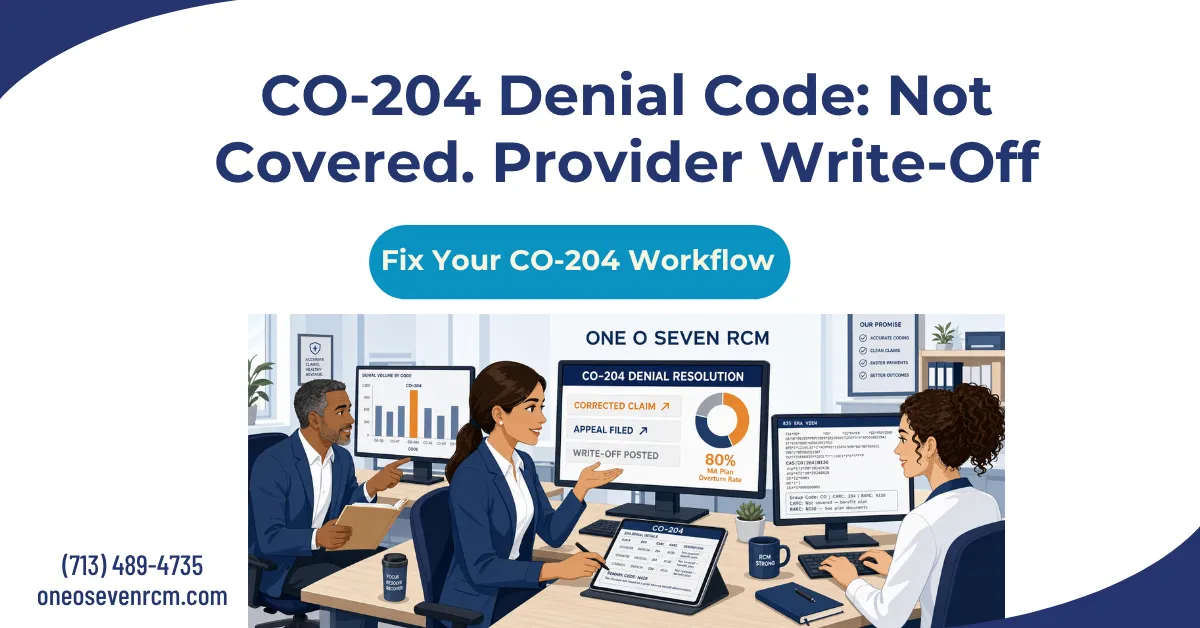
The CO-204 denial code appears on your 835 Electronic Remittance Advice (ERA) or Explanation of Benefits (EOB) when a payer determines that the billed service, equipment, or drug isn’t covered under the patient’s current benefit plan.
The official X12 definition of CARC 204 is: “This service/equipment/drug is not covered under the patient’s current benefit plan.” The CO prefix means Contractual Obligation. The provider must write off the balance. You can’t bill the patient for this amount, and doing so is a compliance violation.
In 2026, with CMS prior authorization rules now live and Medicare Advantage enrollment above 35 million, CO-204 denials are hitting AR queues harder than ever. This guide covers every cause, the correct resolution workflow, the remark code crosswalk, and what you can and can’t do about the write-off.
This article is written for medical billers and AR specialists managing remittance workflows, not for patients.
What Is the CO-204 Denial Code?
The co 204 denial code combines an official Claim Adjustment Group Code (CO) with CARC 204 to tell you exactly who absorbs a non-covered service and how the denial appears on your ERA.
The Official CARC Definition
The X12 CARC official list maintains CARC 204 with the exact description: “This service/equipment/drug is not covered under the patient’s current benefit plan.” This phrase appears in quotation marks because it’s the X12 standardized language. You’ll see it on the 835 ERA in the CAS segment alongside the CO group code.
CARC 204 is not a coding error. It’s not a missing-information denial. It’s not a medical necessity denial. It’s a benefit plan design decision by the payer, meaning the plan simply doesn’t cover this service regardless of clinical appropriateness.
That distinction matters because the resolution path for a benefit plan exclusion is completely different from the resolution path for a documentation deficiency.
If CO-204 appears on your ERA with no accompanying Remittance Advice Remark Code (RARC), the payer hasn’t met the X12 835 transaction standard. Contact the payer and request the specific RARC before doing anything else.
The Two-Component Code Breakdown
CO stands for Claim Adjustment Group Code, issued by X12. It means Contractual Obligation. The provider is financially responsible for the adjustment. Medicare, Medicaid, and commercial payers all use the CO group code. Per Noridian claim adjustment group codes guidance, when CO appears on a remittance, the beneficiary may not be billed.
204 is the CARC. Its official description is not covered under current benefit plan. CARC 204 has been active since February 28, 2007. The CARC list is updated three times per year by the Washington Publishing Company.
How CO-204 Appears on Your ERA
CO-204 is a post-processing denial, not a front-end rejection. Your billing software shows a $0 payment line on the service line with CO in the group code field and 204 in the CARC field, inside the CAS segment of the 835 ERA.
The denial code co 204 always requires at least one accompanying RARC per X12 835 standards.
CO-204 vs. PR-204: Who Owes the Money?
CO-204 is not the patient’s responsibility. When the CO group code appears on your remittance alongside CARC 204, the provider absorbs the adjustment as a contractual write-off. You can’t transfer that balance to the patient. Doing so violates your payer contract and, on Medicare claims, violates CMS program rules.
| Group Code | What It Means | Your Required Action |
|---|---|---|
| CO-204 | Provider absorbs the write-off per payer contract. Patient cannot be billed. | Write off the balance. Do not send a patient statement. Investigate for appeal or correction opportunity. |
| PR-204 | Service not covered, but financial liability falls on the patient. | Confirm patient was notified before service (ABN or non-coverage consent). Bill patient if proper notice exists. |
| OA-204 | Payer-initiated adjustment, neither provider nor patient is automatically liable. | Investigate the payer’s reason. Contact payer for clarification before any write-off or billing action. |
When the payer sends CO-204 and the billing team bills the patient anyway, that’s a contract violation. Per CGS Medicare CO vs PR billing guidance, CO adjustments are the provider’s financial responsibility and the beneficiary cannot be billed. That’s a program requirement, not a suggestion.
If your billing team sees a non-covered charges denial code alongside CO-204, treat them as distinct denial types requiring separate resolution workflows.
What Happens If You Bill the Patient for a CO-204 Denial?
Three consequences follow when a provider bills a patient for a CO group adjustment. First, it’s a payer contract violation. When you signed your participating provider agreement, you agreed to honor the payer’s adjustment determinations. Billing the patient for a CO amount is a breach.
Second, on Medicare claims specifically, Noridian states that the beneficiary may not be billed for CO amounts. Third, a patient who receives a bill for a CO-204 write-off amount will dispute it, creating administrative cost that exceeds the original denied amount.
If your billing team isn’t sure whether a denial is CO or PR, One O Seven RCM’s AR specialists review group code assignments before any patient statement goes out.
Common Reasons You’re Getting CO-204 Denials
The co 204 denial code reason for a specific claim determines whether you’re looking at a correctable billing issue, an appeal opportunity, or a mandatory write-off. Identifying the right root cause is the only way to pick the right resolution path.
Cause 1: The Service Is Excluded From the Benefit Plan
This is the primary cause. The payer’s benefit design explicitly excludes the CPT or HCPCS code billed. Common examples include cosmetic procedures, experimental treatments, and specific therapies the plan doesn’t cover.
This is a plan design decision, not a clinical decision. A service can be completely medically appropriate and still trigger the denial code co 204 if the benefit plan excludes the service category.
A clinic billing CPT 90867 for TMS therapy when the patient’s plan excludes TMS will receive CO-204. The clinic must write off the charge unless the patient signed a non-coverage agreement before the service.
Cause 2: Missing or Invalid Prior Authorization
Missing prior authorization is the most preventable cause of co 204 denial code volume. When a service requires prior auth and it wasn’t obtained, many payers treat the claim as non-covered and fire CO-204.
This differs from CO-50 (medical necessity): CO-50 fires when auth was obtained but documentation didn’t support necessity. CO-204 fires when auth was never obtained and the payer treats its absence as a coverage failure.
As of January 1, 2026, CMS-0057-F Prior Authorization Final Rule requires standard PA decisions within 7 calendar days. If a payer exceeds 7 days on a standard PA request and then denies the claim as non-covered, that denial may be challengeable on procedural grounds.
See our guide to prior authorization in medical billing for the full 2026 workflow.
Cause 3: Wrong Procedure Code or Place of Service
This cause is recoverable. The service IS covered, but how it was billed makes it look non-covered to the payer’s adjudication system. Common triggers include wrong CPT selection for the intended service, a missing or incorrect modifier, and the wrong place of service (POS) code for a telehealth medical billing claim.
Billers often assume CO-204 means the service is truly non-covered. When this is the root cause, correcting the code and resubmitting as a corrected claim recovers the revenue. Check for a coding configuration error before assuming the denial is final.
Cause 4: Billing the Wrong Benefit Administrator
Some members have separate benefit administrators for behavioral health, pharmacy, dental, or vision services, called carve-outs. If the provider bills the medical plan for a service carved out to the behavioral health plan, the medical plan fires CO-204.
Re-run eligibility to confirm the correct payer for the benefit category, then refile to the correct administrator with the correct payer ID.
Cause 5: Benefit Limits or Annual Maximum Exhausted
Some CO-204 denials fire not because the service is excluded but because the patient has reached the plan’s visit limit, session cap, or annual benefit maximum for that service category. Physical therapy visit limits, mental health session caps, and chiropractic treatment limits are the most common scenarios.
Check the patient’s benefit accumulation before assuming the service is permanently excluded.
Cause 6: Out-of-Network Provider Exclusion
For HMO plans and certain PPO tiers, services from out-of-network providers receive no reimbursement. The payer treats the service as non-covered because the provider isn’t in the patient’s network, and CO-204 fires. This isn’t the same as CO-96 where the payer’s internal policy excludes the charge.
This is a network exclusion operating at the benefit plan level.
CO-204 Remark Codes: N220, N130, and What They Mean for Your Claim
The CARC (204) tells you why payment was adjusted. The RARC tells you what to do about it. CO-204 must always be accompanied by at least one RARC on the 835 ERA.
If no RARC appears alongside co204 denial code on the remittance, the payer hasn’t met the X12 835 transaction standard. Request the missing RARC before any other action.
| RARC Code | RARC Description | What It Means for CO-204 | Recommended Action |
|---|---|---|---|
| N130 | Consult plan benefit documents/member handbook for coverage information | Payer is pointing to the benefit exclusion in plan documents | Pull the patient’s Summary of Benefits. Confirm exclusion exists. If confirmed, write off. If disputed, appeal citing plan document language. |
| N220 | Alert: See status details in the 277 transaction | Payer sent additional status information in the 277 Health Care Claim Status transaction | Pull the 277 from your clearinghouse or payer portal. Read status details before taking any other step. |
| N428 | Not covered when performed in this place of service | Service IS covered under the plan but not in the billed POS , this is a recoverable CO-204 | Correct the POS code and resubmit as a corrected claim, or verify the correct POS was used and appeal if payer erred. |
| MA15 | Payment adjusted because the submitted authorization number is missing, invalid, or does not apply | Authorization issue is the root cause of the non-coverage determination | Obtain retro-authorization if available. Resubmit with corrected authorization reference. |
See Noridian CO-204 and N130 guidance for the MAC-specific interpretation of these remark codes.
How to Use the RARC to Determine Your Next Step
Path 1 (Reroute or Refile): If the RARC indicates a wrong benefit administrator or plan routing issue, refile to the correct payer. The n220 remark code pointing to the 277 transaction is your first signal to investigate routing before acting.
Path 2 (Correct and Resubmit): If the RARC indicates a billing configuration issue (wrong POS, wrong code, wrong modifier), correct and resubmit as a corrected claim. N428 with co 204 denial code almost always takes this path.
Path 3 (Appeal and Medical Policy): If the RARC confirms a plan exclusion but you believe the exclusion was applied incorrectly, build a formal appeal citing the plan’s own benefit documents. N130 paired with CO-204 takes this path when the exclusion is disputed.
Is CO-204 the Patient’s Responsibility?
No. CO-204 is not the patient’s responsibility. When the CO group code appears with CARC 204, the provider absorbs the write-off under the terms of the payer contract. This applies across Medicare, Medicaid managed care, and commercial payer contracts.
CMS’s Medicare Claims Processing Manual, Chapter 1, states that CO adjustments are generally write-offs and are not billed to the patient. For Original Medicare specifically, Noridian confirms the beneficiary may not be billed for CO adjustment amounts. These aren’t guidelines. They’re program requirements with compliance consequences for practices that don’t follow them.
The Advance Beneficiary Notice (ABN) is the only mechanism that can legitimately shift CO-204 financial responsibility in limited Medicare FFS scenarios. That process is covered fully in Section 10. If you’re working a Medicare claim and the ABN pathway might apply, read that section before posting the write-off.
When CO-204 Can Shift to Patient Responsibility
There are two specific scenarios where what starts as CO-204 can become patient responsibility. Understanding these prevents both premature write-offs and compliance violations.
Scenario 1: The payer reprocesses the claim and changes the group code from CO to PR. This happens when an appeal is successful in establishing the correct financial routing. If the payer issues a corrected remittance with PR-204 instead of CO-204, the patient may owe the balance subject to proper prior notice requirements.
Scenario 2: For Medicare FFS non-covered services only, when an Advance Beneficiary Notice (ABN Form CMS-R-131) was properly issued and signed before the service was rendered, the provider can use modifier GY to indicate statutory exclusion, submit the claim to Medicare for a denial, and then bill the patient. This is a specific pathway with specific modifier requirements. No ABN means no patient billing. That’s the rule.
Using co 204 denial code resolution correctly in these two scenarios keeps your contractual write-offs accurate and your compliance file clean.
If you’re not sure whether a CO-204 denial on your current payer mix can be shifted to patient responsibility, One O Seven RCM’s billing specialists review remittance group codes and prior authorization services requirements before any patient statement goes out.
How to Resolve a CO-204 Denial: Step-by-Step
Not every CO-204 denial gets the same response. The root cause determines whether you’re correcting a billing error, filing an appeal, or writing off the balance. Most billing teams skip to the write-off without checking. That’s where the revenue leaks. Work through these steps in order before you touch the adjustment in your system.
Step 1: Confirm You Have CO-204, Not PR-204
Pull the ERA and read the group code field in the CAS segment. CO and PR look similar in some billing system interfaces. Confirming the group code is CO before doing anything else prevents the two most common errors: writing off a balance the patient owes (if it’s actually PR-204) and billing the patient for a balance the provider must absorb (if it’s CO-204). This step takes 30 seconds and prevents compliance exposure.
Step 2: Pull Every RARC on the Same Claim Line
The RARC tells you the specific reason for the CO-204 adjustment. CO-204 with N130 means the exclusion is in the benefit documents. CO-204 with N428 means the POS code is the problem. CO-204 with MA15 means authorization is the root cause. Each RARC sends you to a different action path.
Reading only the CARC (204) and ignoring the RARC is like reading a denial code and ignoring the explanation. Refer to the RARC crosswalk table in the remark codes section above for the full decision framework for each code pairing.
Step 3: Verify Patient Eligibility and Benefits for the Date of Service
Run eligibility verification for the specific date of service, not the current date. A patient’s benefits can change mid-year. Confirm the specific CPT code is in the benefit plan. Check whether the patient has a separate benefit administrator for the service category (behavioral health, pharmacy, vision). Check whether the patient has hit a visit or session limit for that service type.
Step 4: Identify Your Root Cause
Map what you found in Steps 2 and 3 to one of three root cause categories. Category A: True exclusion (the service is permanently outside the plan design). Category B: Billing configuration error (the service is covered but something in the claim is wrong). Category C: Administrative failure (missing authorization, wrong payer routed, wrong POS). Category A leads to write-off or appeal. Category B leads to corrected claim. Category C leads to correction, retro-authorization, or rerouting.
Step 5: Determine Your Action Path
Three paths only. No guessing.
Path 1 (Corrected Claim): Use this when the root cause is Category B or C. Fix the code, modifier, POS, or authorization reference. Resubmit through the payer’s corrected medical claim submission process. Do not resubmit as a new claim. Payers treat new claim resubmission on a previously adjudicated claim as a duplicate and deny it as OA-18 denial code.
Path 2 (Appeal): Use this when the root cause is a disputed exclusion, an incorrect MA plan internal criteria application, or a payer error. Build the appeal with benefit document language. For Medicare Advantage claims, cite NCD and LCD standards per the 2026 CMS MA final rule codification.
Path 3 (Write-Off): Use this only after confirming the denial is valid and no correction or appeal path applies. Post the CO adjustment to contractual adjustments. Do not bill the patient.
Step 6: Correct the Claim or Build the Appeal
For corrected claims: follow the payer’s corrected claim submission process. Most payers require a claim frequency code of 7 (replacement) on the UB-04 or a special indicator on the CMS-1500. Submit through the same channel as the original claim. Include the original claim number in the appropriate field.
For appeals: the package must include a cover letter referencing the original claim number and denial date, corrected claim information if applicable, medical records supporting coverage or medical necessity, and a copy of the original remittance.
Step 7: Track Your Filing Deadlines
Medicare requires appeals within 120 days of the remittance date for redetermination (Level 1). Commercial payers typically allow 90 to 180 days. See Medicare redetermination filing requirements for the MAC-specific appeal window for your jurisdiction.
Missing the appeal window is the most common reason recoverable CO-204 revenue gets written off permanently. Build a denial tracking log that records the remittance date, the appeal deadline, and the assigned staff member for every open CO-204 denial. Review the log weekly.
If your team’s denial queue has CO-204 denials sitting past 60 days with no action assigned, One O Seven RCM’s AR follow-up specialists identify root causes, build corrected claims, and file appeals within payer deadlines.
Most recoverable CO-204 revenue is lost not because it can’t be recovered but because no one worked the denial in time.
Can You Appeal a CO-204 Denial?
CMS data shows that Medicare Advantage plans overturn 80% of their claim denials when those denials are appealed to the plan. Most practices don’t appeal CO-204 denials because they assume the plan exclusion is final. It isn’t.
Many CO-204 denials from Medicare Advantage plans are issued based on internal coverage criteria that conflict with active National Coverage Determinations (NCDs) and Local Coverage Determinations (LCDs). Under the 2026 CMS MA final rule, those internal criteria denials are now directly challengeable.
The 2026 Federal Register raised the ALJ hearing threshold to $200 (up from $190 in 2025) and the Federal District Court threshold to $1,960 (up from $1,900 in 2025). Claims can be aggregated to meet the threshold. A practice with 40 CO-204 denials at $50 each can aggregate them to reach the ALJ level.
When a CO-204 Appeal Has a Strong Chance of Success
Three scenarios where appeal beats write-off.
Scenario 1: The MA plan used internal coverage criteria to deny the claim but an active NCD or LCD supports the service. Under the 2026 CMS MA final rule codification, this is the strongest appeal argument available this year.
Scenario 2: The CO-204 denial was triggered by a coding configuration error that looks like a coverage exclusion. Correcting the code and resubmitting through corrected claim submission is technically a corrected claim, not an appeal, but the outcome is the same: revenue recovery.
Scenario 3: The payer applied CO-204 to a service that the EOB or benefit documents actually cover when the correct POS or modifier is used. Check the n220 remark code and related RARC codes before dismissing this scenario. This is a payer error and the appeal needs only the benefit document excerpt plus the corrected claim.
The Five-Level Medicare Appeals Process for CO-204
| Level | Appeal Type | Who Handles It | Filing Deadline | 2026 Dollar Threshold |
|---|---|---|---|---|
| Level 1 | Redetermination | MAC (Medicare Administrative Contractor) | 120 days from remittance date | None |
| Level 2 | Reconsideration | QIC (Qualified Independent Contractor) | 180 days from Level 1 denial | None |
| Level 3 | ALJ Hearing | Office of Medicare Hearings and Appeals | 60 days from Level 2 denial | $200 (up from $190 in 2025) |
| Level 4 | Medicare Appeals Council | Departmental Appeals Board | 60 days from Level 3 denial | None |
| Level 5 | Federal District Court | Federal judiciary | 60 days from Level 4 denial | $1,960 (up from $1,900 in 2025) |
The $200 and $1,960 thresholds are confirmed in the Federal Register CY 2026 appeal threshold update. Claims can be aggregated to reach these thresholds.
Building a Winning CO-204 Appeal Letter
Four elements every CO-204 appeal package must contain. Element 1: The original claim number and remittance date, referenced in the cover letter opening line. Element 2: A quote from the payer’s published medical policy or the NCD/LCD confirming the service is covered under the criteria met by this patient.
Element 3: Clinical documentation mapping the patient’s case to each criterion in the payer’s policy. Don’t write a generic medical necessity argument. Quote the payer’s own criteria and answer each one with chart evidence. Element 4: The corrected claim if a billing configuration error contributed to the denial.
One O Seven RCM’s denial management team builds CO-204 appeal packages that cite payer medical policy language directly, because generic appeal letters on non-covered service denials almost never succeed.
CO-204 and Secondary Insurance: Checking Coordination of Benefits First
Before writing off a CO-204 denial, check whether the patient has secondary insurance. If the primary payer returns CO-204, it means the service isn’t covered under the primary plan. But the secondary plan may cover the service or have different benefit terms.
Billing secondary is a legitimate recovery pathway that most billing teams skip because they process CO-204 as an immediate write-off.
When to Check Secondary Insurance Before Writing Off CO-204
Three conditions make secondary insurance worth pursuing before you post the adjustment.
Condition 1: The patient has a secondary plan through a different employer, a Medicare supplement, or a Medicaid wrap-around. If the primary plan excludes a service, the secondary plan’s benefit terms apply independently.
Condition 2: The CO-204 came from a commercial primary payer and the patient’s secondary is Medicare or Medicaid. Federal and state programs sometimes cover services that commercial plans exclude. Check the secondary payer’s eligibility response for the specific CPT code before assuming a denial.
Condition 3: The patient has a Medicare supplement (Medigap) plan. The specific Medigap plan letter determines coverage. Some Medigap plans include services that Original Medicare excludes under certain conditions. Route the claim to the secondary payer with the primary remittance attached. Don’t assume the secondary will deny because the primary denied.
One compliance note: if the secondary pays and the total reimbursement exceeds the provider’s fee schedule, the excess must be refunded. Overpayment on COB claims is a compliance issue. Use the secondary claim submission pathway that includes the primary remittance attachment to prevent over-collection.
One O Seven RCM’s COB workflow checks secondary eligibility on every CO-204 denial before any write-off is posted, because secondary recoveries on non-covered primary denials are the most underused revenue stream in outpatient billing.
CO-204 Write-Off Policy: What You Must Do After a Valid Denial
When a CO-204 denial is valid and no correction, appeal, or secondary insurance pathway applies, the write-off is mandatory. You post the denied amount to contractual adjustments in your practice management system. You don’t send a patient statement. You don’t send the account to collections. The write-off closes the claim at the contractual adjustment amount.
How to Post a CO-204 Write-Off Correctly
Step 1: Verify the group code is CO and confirm no RARC indicates a correction or rerouting opportunity. Step 2: Post the adjustment to the contractual write-off bucket in your practice management system, not to bad debt or uncollectible accounts. CO-204 is a contractual write-off, not a collection failure.
Step 3: Don’t generate a patient statement for the CO-204 adjusted amount. Step 4: Document the denial code, remittance date, and write-off amount in your denial log for monthly review and root cause analysis.
The ABN and CO-204: What Medicare FFS Providers Must Know
In Medicare FFS, there’s one pathway to shift a non-covered service’s financial responsibility to the patient: the Advance Beneficiary Notice of Noncoverage (ABN), Form CMS-R-131. The ABN must be issued and signed before the service is rendered. It can’t be backdated.
When a valid ABN exists, the provider submits the claim to Medicare with modifier GY (item or service is statutorily excluded), receives the CO-204 denial, and then bills the patient.
Without a valid ABN, even a medically unnecessary or excluded service can’t be billed to the Medicare patient after CO-204. No ABN means no patient billing.
The Medicare ABN modifiers are: GA (ABN was issued), GX (notice issued, voluntary), GY (statutory exclusion), GZ (expected to be denied as not medically necessary, no ABN issued). The modifier you use on the claim determines whether patient billing is permitted after the CO-204 denial.
See CMS Advance Beneficiary Notice FFS guidelines for the full modifier criteria.
The 2026 ABN Form Update: May 12, 2026 Transition Deadline
CMS updated the ABN form effective March 13, 2026. The updated ABN is valid and expires March 31, 2029. Providers could continue using the expired ABN form until May 12, 2026. After May 12, 2026, all ABN issuances must use the updated form.
Practices still using the old form after May 12, 2026 are issuing invalid notices. When the notice is invalid, the patient liability transfer mechanism is also invalid. Verify which ABN version your front desk is using right now and update immediately if it’s the expired version.
If your front desk isn’t sure which ABN version is currently in use, One O Seven RCM reviews patient notification workflows as part of our denial prevention audit for new clients.
2026 CMS Updates That Directly Affect CO-204 Denial Volume
Three major CMS actions in 2026 directly affect how CO-204 denials are triggered and challenged. Knowing these changes tells your billing team where new denial volume is coming from and where your strongest appeal arguments now live.
CMS-0057-F: The 7-Day Prior Authorization Rule (Live January 1, 2026)
The CMS-0057-F Prior Authorization Final Rule went live January 1, 2026. Standard prior authorization decisions must now be made within 7 calendar days. Expedited decisions within 72 hours. This rule applies to Medicare Advantage, state Medicaid FFS, CHIP FFS, Medicaid and CHIP managed care plans, and QHP issuers on Federal Exchanges.
CO-204 connection: when a payer exceeds the 7-day standard PA timeline and then denies the service as non-covered, the resulting CO-204 may be challengeable on procedural grounds. Document the date your PA request was submitted and the date the denial was received.
If the gap exceeds 7 days, include that timeline in your appeal package. See our guide to prior authorization in medical billing for the updated 2026 workflow.
The WISeR Model: Original Medicare Now Requires PA for Select Services
CMS launched the CMS WISeR Model prior authorization on January 1, 2026. This is the first time Original Medicare has required prior authorization for select outpatient services. Covered services include percutaneous image-guided lumbar decompression, arthroscopic knee lavage and debridement, epidural steroid injections, and percutaneous vertebral augmentation.
CO-204 connection: providers billing WISeR-designated services in the six participating states without prior authorization will receive CO-204 denials under Original Medicare for the first time. Authorizations are valid for 120 calendar days once approved.
CMS-0062-P: Drug Prior Authorization Proposed Rule (Comment Deadline June 15, 2026)
CMS published the CMS-0062-P Drug Prior Authorization proposed rule on April 10, 2026. This rule extends prior authorization requirements to drugs for the first time. It proposes standard PA decisions within 72 hours and urgent decisions within 24 hours for drug claims. The public comment period closes June 15, 2026.
CO-204 connection: pharmaceutical CO-204 denials covering infusions, injectables, and specialty drugs will face new PA requirements once this rule is finalized. Practices billing high volumes of specialty pharmaceuticals should monitor this rule actively.
2026 Medicare Advantage Coverage Criteria Changes
CMS codified requirements in the 2026 MA final rule specifying that MA plans must use NCD and LCD standards when making medical necessity determinations. When MA plans apply internal coverage criteria that conflict with an active NCD or LCD, that conflict is your strongest CO-204 appeal argument.
CMS data shows MA plans overturn 80% of their denied claims when appealed. Most practices don’t appeal CO-204 denials from MA plans. That’s the gap your billing team should close immediately.
Staying current on CMS regulatory changes is the front-end prevention work that keeps CO-204 volume from growing. One O Seven RCM monitors payer policy updates and PA requirement changes across all major payers so your team’s workflows reflect what’s actually in effect right now.
How to Prevent CO-204 Denial Code Denials: A Front-to-Back Checklist
Bing Copilot has cited prevention checklists for CO-204 from flat bullet lists. Our version organizes prevention into front-end, mid-cycle, and back-end controls because CO-204 enters the denial queue from three different points in the billing cycle.
Front-End Prevention (Before the Date of Service)
- Verify patient eligibility and benefits for the specific CPT code, not just active insurance status, before every appointment.
- Confirm whether the service requires prior authorization and obtain it before the date of service, not after.
- Check for benefit carve-outs (behavioral health, pharmacy, vision) and store the correct payer ID for each carve-out in your system.
- For Medicare FFS patients, determine whether the service is a WISeR-designated procedure requiring prior authorization as of January 1, 2026.
- Issue and obtain a signed ABN before rendering any service that Medicare may exclude, using the updated ABN form effective May 12, 2026.
- Verify that the rendering provider is in-network for the patient’s specific plan tier before the service is delivered.
Mid-Cycle Prevention (Coding and Charge Capture)
- Validate CPT and HCPCS code selection against payer medical policy before submission, not just against ICD-10 coding guidelines.
- Check the place of service code against the payer’s benefit terms, particularly for telehealth claims where POS 02 and POS 10 carry different coverage rules across payers.
- Confirm modifier accuracy, especially GA, GY, GX, and GZ on Medicare claims where ABN status determines patient billing eligibility.
- Review ICD-10 to CPT linkage for diagnosis-procedure pairs where payers apply coverage policies that treat mismatched codes as non-covered services.
Back-End Prevention (Denial Tracking and Workflow)
- Post every CO-204 denial with the full Code Trio: Group Code plus CARC plus all RARCs. Never flatten a CO-204 denial into a single “non-covered” bucket without capturing the RARC.
- Maintain a denial tracking log that records the remittance date, the appeal deadline, the assigned team member, and the root cause category for every CO-204 denial.
- Review CO-204 denial patterns monthly by CPT code, payer, and root cause category to identify systemic billing workflow gaps.
- Set automated alerts in your billing system for CO-204 denials exceeding 30 days without a resolution action assigned.
One O Seven RCM builds payer-specific prevention checklists for each denial code type, including CO-204, so billing teams aren’t relying on generic advice that doesn’t account for how your specific payer mix actually adjudicates non-coverage claims.
Frequently Asked Questions About CO-204 Denial Code in 2026
What does code 204 mean?
Code 204 is a Claim Adjustment Reason Code (CARC) used on the 835 ERA and EOB. It means the billed service, equipment, or drug isn’t covered under the patient’s current benefit plan. It doesn’t mean the service was unnecessary or that the claim had an error.
It means the benefit plan’s design excludes that specific item.
What is CO-204?
CO-204 combines two codes. CO is the Claim Adjustment Group Code meaning Contractual Obligation. 204 is the CARC meaning service not covered under the patient’s benefit plan. Together they mean the payer has determined the service isn’t covered and the provider must absorb the write-off. The patient can’t be billed.
Is CO-204 the patient’s responsibility?
No. CO-204 is not the patient’s responsibility. The CO group code means the provider absorbs the write-off under the payer contract. Billing the patient for a CO-204 adjustment violates the provider’s contract with the payer. On Medicare claims, it also violates CMS program rules.
What is a PR-204 denial code?
PR-204 uses the same CARC 204 (service not covered under the benefit plan) but with the Patient Responsibility group code. PR means the patient owes the balance, not the provider. CO-204 means the provider writes off the balance. The group code prefix (CO vs PR) is the key distinction that determines who pays.
How do I resolve a CO-204 denial code?
Start by confirming the group code is CO, then pull every RARC on the denial line. The RARC tells you whether to correct and resubmit, reroute to a different payer, or appeal. If no correction or appeal path applies, post the amount to contractual adjustments. Never send a patient statement for a CO-204 write-off amount.
Can a CO-204 denial be appealed?
Yes, CO-204 denials can be appealed, especially from Medicare Advantage plans. CMS data shows MA plans overturn 80% of their denied claims when appealed. The strongest 2026 appeal argument is that the MA plan used internal coverage criteria that conflict with an active NCD or LCD.
Build the appeal with specific payer medical policy language rather than a generic medical necessity letter.
What is the n220 remark code on a CO-204 denial?
N220 is a Remittance Advice Remark Code (RARC) that means “Alert: See status details in the 277 transaction.” When N220 appears with CO-204, pull the 277 Health Care Claim Status transaction from your clearinghouse or payer portal. Read the status details before determining your next action.
What is the difference between CO-204 and CO-96?
CO-96 means the charge is non-covered based on the payer’s own internal exclusion policy. CO-204 means the service isn’t covered under the patient’s benefit plan design. CO-96 is a payer-level exclusion. CO-204 is a plan-level exclusion. For the full CO-96 denial code resolution workflow, see our dedicated guide.
How long do I have to appeal a CO-204 denial?
For Medicare, you have 120 days from the remittance date to file a redetermination (Level 1 appeal). Commercial payers typically allow 90 to 180 days. Missing the appeal window on a CO-204 denial permanently forecloses the recovery opportunity. Check your payer’s provider manual for the exact deadline on each payer in your mix.
What is the CO-204 denial code description?
The official CO-204 denial code description, as maintained by X12 CARC official list under the HIPAA-mandated CARC system, is: “This service/equipment/drug is not covered under the patient’s current benefit plan.” The code has been active since February 28, 2007.
The CARC list is updated three times per year by the Washington Publishing Company. The description hasn’t changed since the code was introduced.